Rewards for journalists. Accountability for corruption
We helped journalists reveal Nigerian PEPs’ US real estate. The impact is increasing.
This week, a group of investigators in Nigeria, the US and Europe used data from ACDC to reveal that a former Nigerian public official facing multiple corruption charges controls more than $1 million dollars of real estate in Florida.
Former education ministry official Dibu Ojerinde is accused of diverting $13.7 million from government departments where he worked for almost two decades. When the case was launched, prosecutors seized assets from Ojerinde and his family, including “a petrol station, schools, hotels, upscale properties in the nation’s capital, Abuja, and shares in various companies,” according to Premium Times Nigeria.
The new investigation by Premium Times, the Platform to Protect Whistleblowers in Africa (PPLAAF) and OCCRP has added two houses in Florida with a combined value of $1.2 million to the list of Ojerinde’s suspected ill-gotten gains. The houses were not included in the original asset seizure and appear not to have been previously known to the Nigerian authorities. As Nigerian authorities sought to seize Ojerinde’s assets in 2019, his sons and daughter-in-law were shuffling ownership of the Florida properties into the name of two anonymous trusts.
PPLAAF identified the properties using a data architecture built by ACDC to pilot a system for tracing international asset ownership in jurisdictions where real estate data is not easily available.
Unlike countries like the UK, France and South Africa, there is no publicly searchable central register of real estate ownership in the United States. US states maintain regional registers, which can be consulted – often for a fee and in person – if you know where to look. When a property is held by a company the trail is even harder to follow: the US has no public register of who ultimately benefits from a corporate entity, either.
However, like most people in the US, the Nigerian officials that our partners were interested in are connected to various property addresses via a trail of breadcrumbs on the internet. Intrepid investigators used official records to turn the breadcrumbs we gathered into impactful reporting.
The Ojerinde example is one of several investigations published by PPLAAF and partners which started with data leads from ACDC.
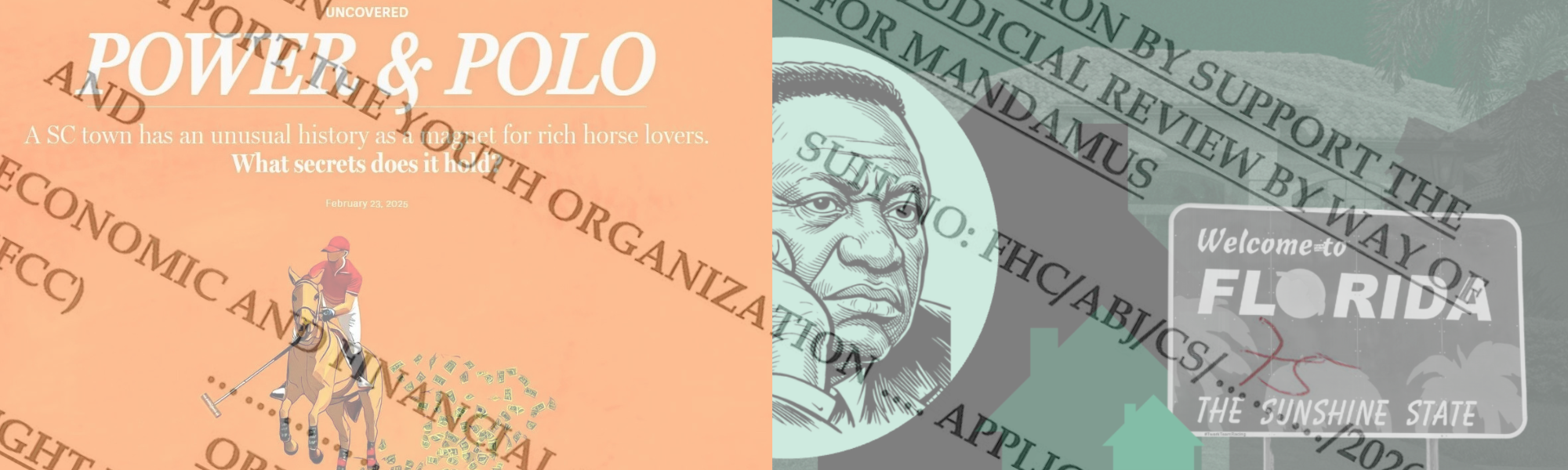
These include Power and Polo, with the South Carolina Post & Courier, OCCRP and the Aiken Standard, which revealed how a former national security official, accused by Nigerian authorities of diverting more than $2 billion from anti-terror funds, had previously acquired a horse farm in Aiken, South Carolina while overseeing Nigeria’s government mint.
The journalists on that story recently became the well-deserved recipients of the 2026 A-Mark Prize for Investigative Journalism from the South Carolina Press Association.
But our goal was always to drive accountability, and we are now seeing signs that local civil society groups are using the findings to pursue justice.
An anti-corruption NGO in Nigeria has called for an investigation into the alleged intermediaries in the Dasuki case. Another Nigerian group, Support the Youth Organization, recently filed a court petition calling on prosecutors to investigate corruption in the oil-rich state of Abia under three governors, including Orji Uzor Kalu. Using ACDC’s data architecture, PPLAAF and the Post and Courier revealed that “during his tenure as governor, Uzor Kalu spent USD 3.3 million on American properties. In the 18 months following his departure from office and while under indictment by Nigerian authorities, he acquired additional properties worth USD 4.4 million,” according to PPLAAF.
In 2019, after over a decade on trial, Kalu was sentenced to 12 years in prison following an indictment on more than 30 corruption and money laundering charges. However, the Supreme Court of Nigeria overturned the verdict on procedural grounds the following year, and called for the case to be retried.
In Nigerian corruption cases, the wheels of justice often turn slowly. But by revealing the full extent of US real estate owned by officials accused of corruption, we can support efforts to return these assets to their rightful owners.
This work is as urgent as ever. In March, a court in Texas struck down a new federal rule bringing anti-money laundering regulations to residential real estate transactions across the US. Without adequate safeguards against corrupt and criminal wealth in the real estate market, it is vital that journalists and civil society can continue to follow the money.

Related Articles
 Blog
Blog
A new documentary shows the central role of whistleblowers in providing anti-corruption evidence
In Whistleblower, a new documentary feature film by German director Marc Bauder, we follow investigative journalists and whistleblower protection ...
 Blog
Blog
Spain’s real estate money laundering problem is probably bigger than Madrid realizes
Spain’s low score on the data part of the Opacity in Real Estate Ownership Index should set alarm bells ringing in Madrid.
 Blog
Blog
Looking Behind the Wall: Data Availability and Advocacy for Stronger AML-CFT Legislation in France
Experience from France illustrates how good data availability allows civil society advocates to pinpoint loopholes and weaknesses in the national AML framework, and push for changes that close the door to illicit cash.