

A case study of BGFIBank DRC
This paper draws on leaked data to examine a case in which correspondent banks processed millions of dollars in suspicious transactions for a private bank that had been captured by the ruling elite of the Democratic Republic of Congo, BGFIBank DRC.
The correspondent banking system allows money to travel from one country to another: a third-party bank uses its access to a jurisdiction or currency, such as the US dollar, to process transactions on behalf of smaller “respondent” banks around the world. Correspondent banks ought to scrutinise unusual transactions.
Amid kleptocratic capture of key domestic institutions, natural resource wealth and inbound investment, BGFIBank DRC processed some $1.6 billion in outgoing foreign transfers from the DRC between 2011 and 2019, the period covered by the data leak. Acting as correspondent banks for BGFIBank DRC, the following banks were responsible for processing the bulk of this volume, including a significant share with the hallmarks of illicit financial flows linked to corruption, kleptocracy and state capture.
Commerzbank processed 76% of BGFIBank DRC’s foreign transfers appearing in the leaked data between 2011 and 2016, equivalent to 68% of the transferred dollar value: almost $800 million. The bank appears to have waved through a $1 million payment to Congo Construction Company (CCC), a shell company used to channel bribes to Kabila’s circle, from Société de Gestion de Péage au Congo (SOPECO), a firm owned by an associate of CCC’s directors that was under investigation in DRC for embezzlement.
Malta’s FIMBank processed international transactions worth more than $250 million during the nine-year period covered by the leak, 83% of which was transferred before 2016. FIMBank ignored explicit warnings from peer financial institutions about Glory Group, the successor to Congo Futur, which had been sanctioned by the US for financing Hezbollah. FIMBank allowed Glory Group companies to funnel nearly $140 million abroad, including transactions justified with invoices for different amounts.
In the summer of 2016, Citibank approved at least $17 million in transfers from Sicomines, a Chinese-Congolese joint venture, to the BGFIBank DRC accounts of CCC. Large transfers were justified with strikingly vague descriptions, including “contract costs” and “payment”
BMCE Bank, the Madrid-based subsidiary (BMCE Bank International) of Morocco’s BMCE Bank (now Bank of Africa), used Citibank to clear large, dollar denominated payments for BGFIBank DRC, including a $9 million payment from Sicomines to CCC.
From 2016 onwards, after Commerzbank cut ties with BGFIBank DRC, BGFIBank International in Paris executed approximately 71% of all outgoing transactions from its Congolese subsidiary. PPLAAF estimates that $450 million in suspicious funds were moved out of BGFIBank DRC and into the international financial system by BGFIBank International, including over $30 million to and from entities connected to the presidential administration. Over 40% of its transactions are potentially suspicious. Although compliance officers at BGFIBank International repeatedly raised concerns, these were routinely overridden or answered with back-dated documents and false paper trails produced by BGFIBank DRC executives in Kinshasa.
The BGFIBank Group, BGFIBank International’s parent company, had declined to respond to the Congo Hold-Up consortium before publication. The banks mentioned in this report have not replied to PPLAAF and ACDC’s requests for comment. In previous responses to Congo Hold-Up, BMCE, Citibank and Commerzbank stressed their general due diligence and ethics procedures.
The report calls on regulators, supervisors, law enforcement and banks to step up scrutiny of high-risk relationships, freezing suspicious transactions until proven legitimate; use technology to strengthen, not replace, human compliance review; protect whistleblowers, including respondent-bank staff; and hold banks and individuals accountable through deterrent fines and, where appropriate, criminal liability.
This research is part of the Governance & Integrity Anti-Corruption Evidence (GI ACE) programme which is hosted by the Centre for the Study of Corruption, University of Sussex and funded by the UK government’s Foreign, Commonwealth & Development Office (FCDO) through its Global Research and Technology Development portfolio. GI-ACE generates actionable evidence that policymakers, practitioners and advocates can use to design and implement more effective anti-corruption initiatives. The views expressed here do not necessarily reflect the UK Government’s official policies.
 Correspondent Banking as a Vector of Illicit Financial Flows: A case study of BGFIBank DRC

Related Articles
 Reports
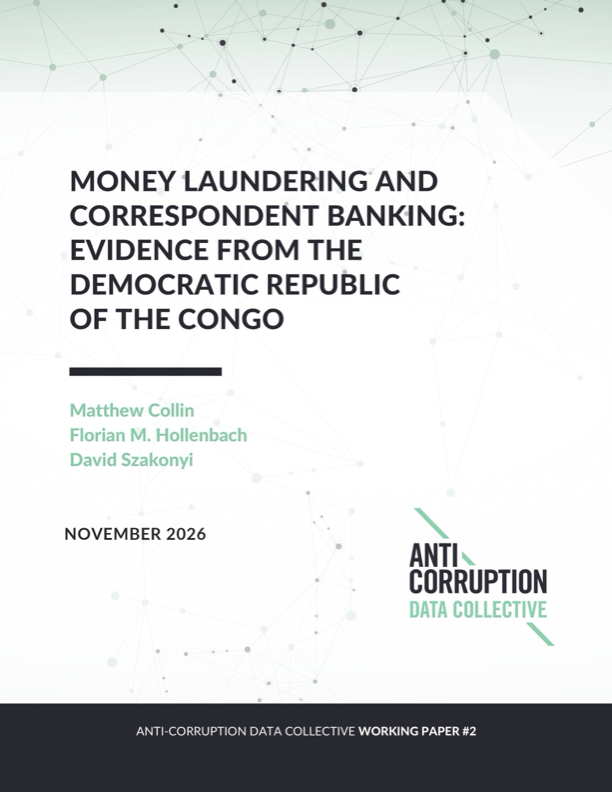
Money Laundering and Correspondent Banking: Evidence from the Democratic Republic of the Congo
This academic working paper provides the first empirical test of de-risking using data from the Congo Hold-Up, the largest financial leak in African history, comprising over 3.5 million documents from BGFIBank.
 Reports
Classifying Insider Trading Risk: Analyzing the Longshot Betting Ecosystem on Polymarket
In a follow-up to ACDC's earlier analysis of insider trading risk on Polymarket, this report defines a profile of digital wallet that most precisely indicates true insider traders. We find 152 such wallets active in military and defence markets.
 Reports
The Leniency Lobby: How the U.S. Lets Global Corruption off the Hook
Alleged criminals and corrupt politicians from around the world are spending millions to lobby for political support, pardons and sanctions relief in Washington, according to analysis of Foreign Agent Registration Act (FARA) filings by ACDC.