Alleged criminals and corrupt politicians from around the world are spending millions to lobby for political support, pardons and sanctions relief in Washington, according to analysis of Foreign Agent Registration Act (FARA) filings by ACDC.
ACDC coded thousands of FARA declarations spanning the previous three presidential administrations and the first 17 months of Trump’s second term. The analysis then honed in on seventy high-risk individuals who have engaged U.S. lobbyists, often to secure removal from sanctions lists, presidential pardons, or otherwise lobby the U.S. government around legal cases linked to corruption, fraud and other offences.
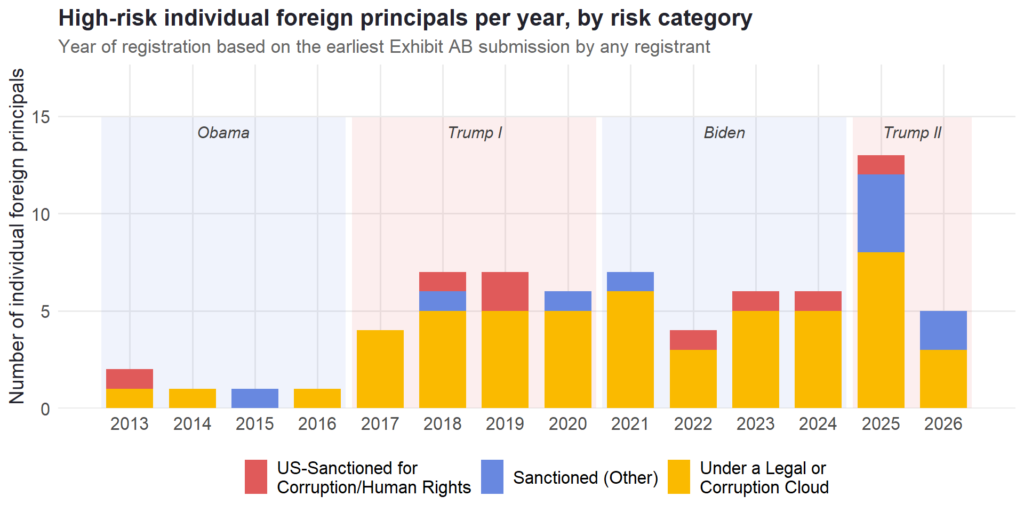
2025 saw a spike in registrations of high-risk clients, with a notable increase in lobbying for individuals under sanctions. This increase coincides with the roll-back of U.S. anti-corruption actions, including the shuttering of USAID, firing of State Department experts, and the closing of the KleptoCapture task force.
The average cost of lobbying campaigns has more than doubled. Under the Biden administration, foreign individuals spent roughly $190,000 on each lobbyist relationship, compared to an average of $490,000 from 2025 onwards. However, despite FARA requiring declaration of spending amounts, we can only see these amounts for two-thirds of lobbying relationships.
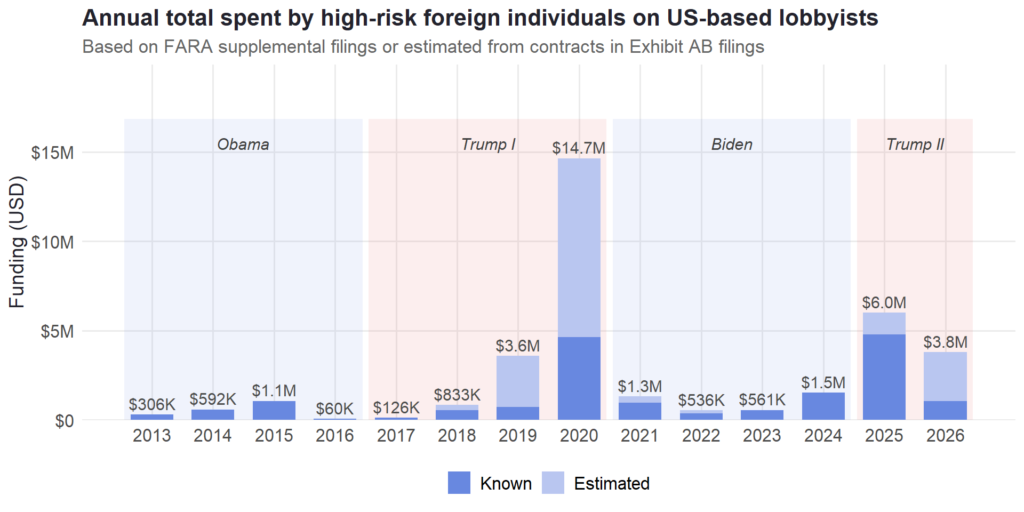
Consistent with broader trends in FARA registrations, declarations of lobbying relationships for high-risk individuals have increased significantly since the 2017 conviction (and later pardon) of Paul Manafort for working as an undeclared lobbyist for the government of Ukraine.
However, several obstacles to full transparency remain, including:
Proxy clients: Political parties, businesses and stand-ins are named as clients for work that is actually designed to benefit high-risk individuals.
Inadequate due diligence into the source of funds used to pay lobbyists’ fees. At least two countries have opened investigations into payments of U.S. lobbyist fees.
Vague and inaccurate filings that understate the scope of political activities, do not include important context about the foreign principal or omit the materials disseminated as part of lobbying efforts
Failure to file at all, or filing only after prosecution or public exposure of lobbying efforts.
Among the cases reviewed for the report:
Albanian opposition leader and former prime minister, Sali Berisha, who was banned from entering the U.S. in 2021 under a State Department 7031(c) designation for involvement in “significant corruption”. His party, the Democratic Party of Albania, signed a contract worth up to $6 million with a Washington lobbying firm. Materials filed under FARA suggest that a main purpose of the campaign was to secure Berisha a waiver allowing him to obtain a U.S. visa.
The current Deputy Prime Minister of Cambodia, Sar Sokha, has engaged U.S. lawyers to help ward off OFAC sanctions after being named in draft legislation targeting professional scam networks, as reported by OCCRP.
A Venezuelan-Italian banker, Julio Herrera Velutini convicted of bribery, conspiracy and wire-fraud in Puerto Rico hired lobbyists to work on behalf of his law firm “to engage with the United States Government on the client’s situation.” The Campaign Legal Center has filed a complaint with the Federal Election Commission alleging that a $3.5 million donation to a Trump super PAC by Herrera Velutini’s daughter was in fact on behalf of her father, who was pardoned by President Trump in January.
The alleged mastermind of the 1MDB embezzlement and money laundering case, Jow Taek Lho, is named in multiple lobbying declarations as a “global philanthropist, investor and entrepreneur” with no mention of his fugitive status or political ties. Low is currently seeking a pardon from the Trump administration.
The DoJ alleged in March 2024 that former Prime Minister of Mongolia, Sukhbaatar Batbold, and his son had bought two luxury New York City apartments with the proceeds of “a corruption scheme.” In late 2024, Batbold and his son hired two lobbying firms, which “met with members of Congress and the incoming Trump Administration to arrange meetings and discuss issues regarding foreign principal’s pending legal matter.” According to 2025 and 2026 filings, the pair paid at least $4.8 million, or a third of the value of the apartments.
“We see a disturbing pattern of lobbying targeting anti-corruption enforcement actions from previous administrations,” said Michelle Kendler-Kretsch, a Research Fellow at ACDC and an author of the report. “If these influence campaigns are successful, this sets a dangerous precedent where the standard for holding corruption accountable shifts according to whoever holds power in Washington. In some cases, information submitted with filings also shows lobbyists attacking anti-corruption infrastructure developed with U.S. support. This threatens to undermine years of progress with impacts not just on the individual cases but countries’ ability to enforce corruption cases.”
Some FARA declarations are explicitly tied to attempts to secure a pardon for the client, including by filing a formal petition. However, other pardon petitions for foreign individuals have no accompanying FARA declaration. A notable example involves Ricardo Alberto Martinelli Linares and Luis Enrique Martinelli Linares of Panama, two sons of the former president, who both pleaded guilty in the U.S. in 2021 to conspiracy to commit money laundering related to bribes in the Odebrecht scandal. La Prensa recently reported that the former president paid for Panamanian lawmakers, including his lawyers, to attend a gala dinner at Mar-a-Lago in April 2025, and made his family’s private plane available to the lawmakers. Pardon petitions for the brothers were filed in 2025 and remain pending.
Recommendations
To bring greater transparency to foreign lobbying and protect anti-corruption efforts in the U.S. and around the world, ACDC recommends that policymakers and the Department of Justice strengthen FARA requirements and improve transparency and accountability.
This should include:
Requiring criminal history, ongoing legal proceedings and sanctions status of the foreign principal to be declared under FARA.
Increasing the specificity of reporting requirements to include specific details on the accusations, cases and other issues that are being addressed through the lobbying.
Clarify the FARA registration requirements for presidential pardon petitioning and lobbying for sanctions delisting.
Increase transparency around payments, including if an intermediary or proxy was used, and instruct lobbyists to conduct enhanced due diligence on the source of their funds if the client is a politically exposed person, is under U.S. sanctions, or has a criminal history.
The Department of Justice should also increase enforcement – with adequate resources allocated – of the current FARA statute, including investigating the use of proxies, true sources of funds, and requiring historical records to be updated to correct identified errors, inaccuracies, omissions and missing files.
 The Leniency Lobby: How the U.S. lets Global Coruption off the Hook

Related Articles
 Reports
Classifying Insider Trading Risk: Analyzing the Longshot Betting Ecosystem on Polymarket
In a follow-up to ACDC's earlier analysis of insider trading risk on Polymarket, this report defines a profile of digital wallet that most precisely indicates true insider traders. We find 152 such wallets active in military and defence markets.
 Reports
Insider Risks in Polymarket Political Markets
Comprehensive analysis of political betting reveals widespread insider trading risks, especially on military and defence markets.
 Reports
Find the Needles, Analyse the Haystack
This report shares findings and insights from the first phase of the Illicit Finance Data Lab, an initiative by ACDC and OCCRP to help scale up meaningful collaboration between investigative journalists and academic researchers working on illicit finance.