
To gain influence in Washington, high-risk foreigners are turning to personal lobbyists rather than big firms
A slew of recent reporting has looked at how a new generation of lobbyists is emerging to shape the Trump administration’s views, change their policies or advocate for causes. These figures are not traditional lobbyists, but people with influence over and access to key members of the Trump administration, often extending all the way to the White House and Trump family. Last week, Anne Applebaum described in The Atlantic, how “informal envoys, private companies, online grifters, and hardened ideologues both inside and outside the government matter more,” than traditional ways of lobbying, diplomacy and policy making. CBS News investigated and interviewed pardon brokers, who charge hundreds of thousands of dollars to petition the White House for clemency, going around the Department of Justice. They justified their fees with costs including fundraising dinners and trips to Mar-a-Lago. Politico Influence reported that a Gen-Z online content creator is conducting influence operations for an Israeli defence company, in at least his second foreign lobbying contract.
Curious how this reporting aligned with larger patterns and areas of concern, ACDC revisited some of the data analysis for our July report into foreign lobbying for high-risk individuals. In that report, we found a thriving and lucrative “leniency lobby” that seeks to secure U.S. political support, pardons and sanctions relief for individuals from around the world who have been implicated in corruption, human rights abuses and other offenses.
Analyzing Foreign Agent Registration Act (FARA) filings going back four administrations, we saw a spike in registrations of high-risk clients under the second Trump presidency, especially those lobbying for sanctions relief. Under Trump 2.0, the average cost of lobbying campaigns has more than doubled for these high-risk clients.
Dowload the report:
The Leniency Lobby: How the U.S. Lets Global Corruption off the Hook
Arrival of the Newcomers
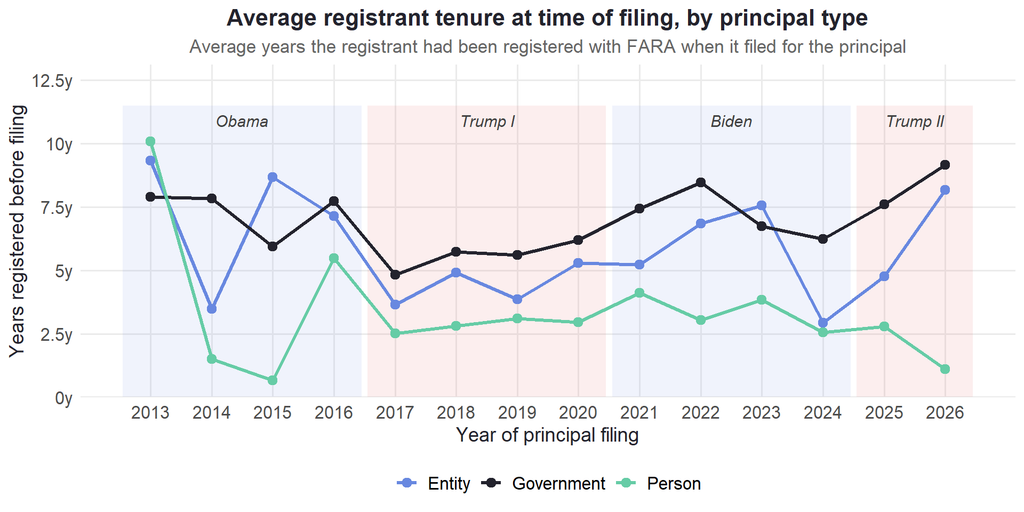
Our research also examined patterns in the types of lobbyists registering their work for foreign people, governments and businesses. Most striking, is the decrease in the last few years in the average tenure – the period of time between the earliest and most recent registration – of lobbyists for individual, natural-person clients. With time, we would expect longer-standing legacy firms to pull up the average as they register new clients. For government and entity clients, this is the pattern we observe (Figure 1), with the average tenure closing in on 10 years for both, despite earlier dips during Trump’s first term.
However, registrants representing individuals are, on average, less experienced than in earlier years. The average is dropping, pulled down by the vast number of first time registrants: 59% of registrants for individual foreign clients from 2024 onwards.
This suggests that the pattern appearing in media reporting – newly influential lobbyists leveraging their access rather than experience – is even more pronounced among those representing foreign individuals.
A Pack of Lone Wolves
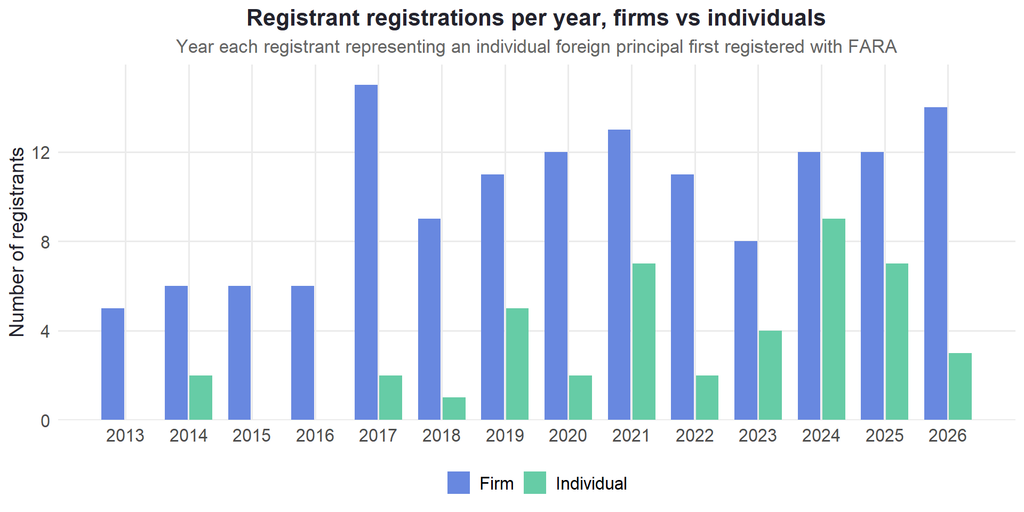
Next, we categorized registrants working for foreign individuals as either a firm or an individual, based on their name. While still only representing a small portion of registrants, individual registrants’ share of new lobbying contracts has been growing, reaching as high as 43% in 2024 and 37% in 2025. We may be underestimating the role of individual lobbyists, as one-person companies set up for lobbying purposes could be counted as firms.
There are a couple of possible, non-exclusive, explanations for this.
Firstly, Paul Manafort’s 2017 conviction (later pardoned) for failure to register as a foreign agent sparked an increase in foreign lobbyist registrations across the board. Before 2017, we see virtually no individual registrants. Smaller, informal lobbying arrangements, sometimes without a formal contact, are now more likely to be reported, for fear of facing prosecution for failure to file.
The uptick in lone-wolf lobbyists may also reflect an increase in a more personalized form of lobbying, in which this new wave of lobbyists cultivate individual relationships within the Trump administration and wider circle, without the backing of a formal firm. Anecdotal evidence from media reporting suggests that experience navigating formal bureaucratic or political structures is now less valuable than knowing the right person.
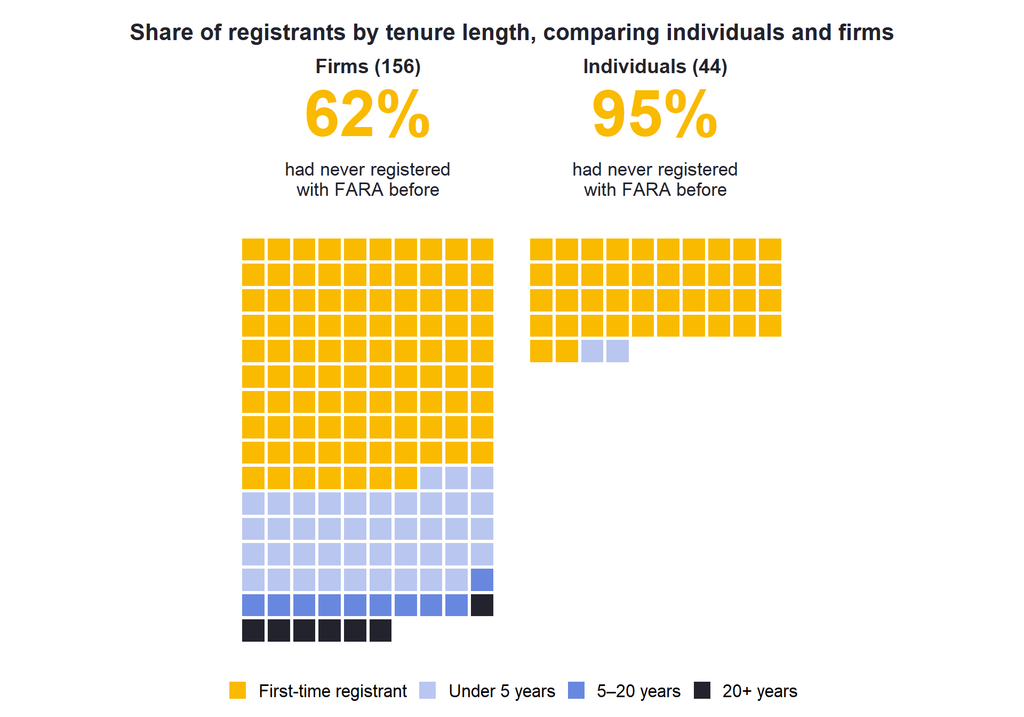
A closer look at the data reveals that individual registrants differ systematically from firms in terms of their experience and where they operate. Firstly, individuals have significantly shorter FARA tenure than firms, as seen in Figure 3. In 95% of cases, they had never registered with FARA before when taking on their first client, compared with 62% of firms. The tenure of firms range from zero to over 40 years, while almost all individual registrants had no experience in foreign lobbying declared under FARA.
Outsiders with the Inside Track
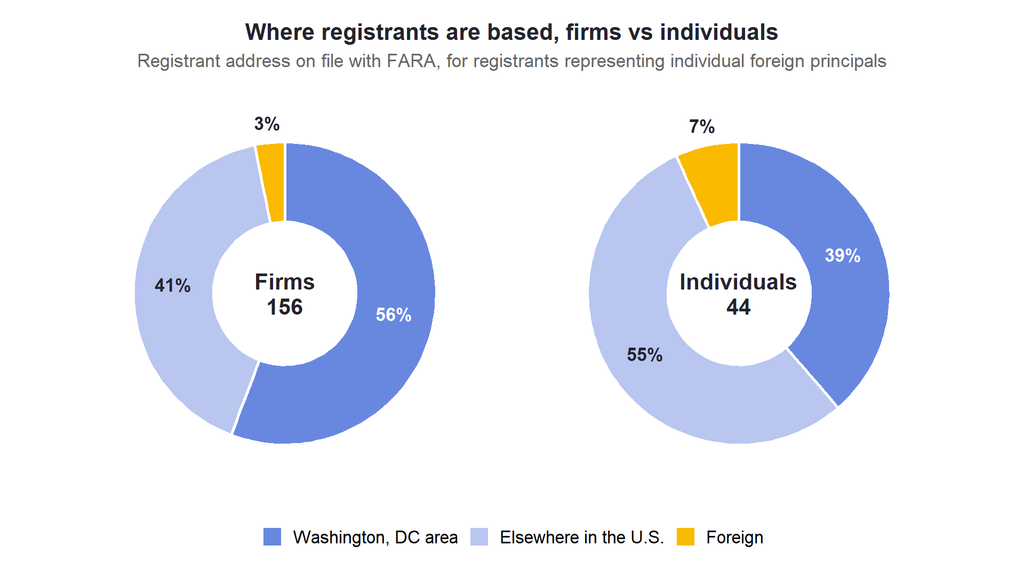
Most individual registrants (61%) list a U.S. address outside the DMV area (DC, Maryland, and Virginia). The DMV represents the traditional epicenter of government lobbying, which is why most firms (56%) are based there. Several individual registrants in the dataset appear to be friends or associates of their clients rather than traditional lobbying professionals, or work in media and communications outside the Beltway.
This pattern suggests lobbying activity is no longer confined to Washington, a shift anecdotally reinforced by Trump’s use of Florida as a parallel base of influence. In Panama, reporting by La Prensa on a tip from ACDC revealed that while two sons of a former President were seeking pardons for U.S. convictions for conspiracy to commit money laundering, Panamanian politicians and lawyers for the family attended fundraising events at Mar-a-Lago. There is no sign in FARA filings of the family engaging U.S. lobbyists in the nation’s capital to support their application.
More Money, Less Process, More Problems
Why should this concern us? It isn’t as if large, established lobbying firms are necessarily more averse to furthering the cause of the world’s criminals and corrupt. In his book Devils’ Advocates, the New York Times journalist Kenneth Vogel tells the story of one lobbyist who made extraordinary gains working for controversial clients under the first Trump administration. His firm is the registrant for many of the high-risk individual foreign principals in our report.
Nonetheless, influence campaigns designed to get around formal structures create their own risks. As does a political climate that makes these campaigns more successful. The data from FARA filings shows that – at least where foreign, natural-person clients are concerned – lobbying in Washington is becoming both more expensive and more personal. This exacerbates the risks of back-room deals, pay-to-play pardons and policies, undue influence and even bribery.
As it is limited to lobbying on behalf of foreign individuals, this analysis gives an admittedly narrow window into the influence world under Trump. Yet, it aligns with the picture emerging from media reporting and investigative work. The most important qualifications for a lobbyist may no longer be experience, access to traditional government officials or the resources of a large firm. Increasingly, people with a case to make before the U.S. government just want a person with the President’s ear.
Related Articles
 Investigations
Sanctions and Sanctuary: A Czech Spa Town and Kremlin-linked Russians
Journalists in Czechia have used data provided by ACDC to map the assets of sanctioned and politically exposed persons from Russia. A famous spa town stands out.
 Investigations
Profiting from War: Mysterious Bets on Polymarket
Some Polymarket users are making a lot of money by placing high-risk bets on wars. Research reveals patterns indicative of possible insider trading.
 Investigations
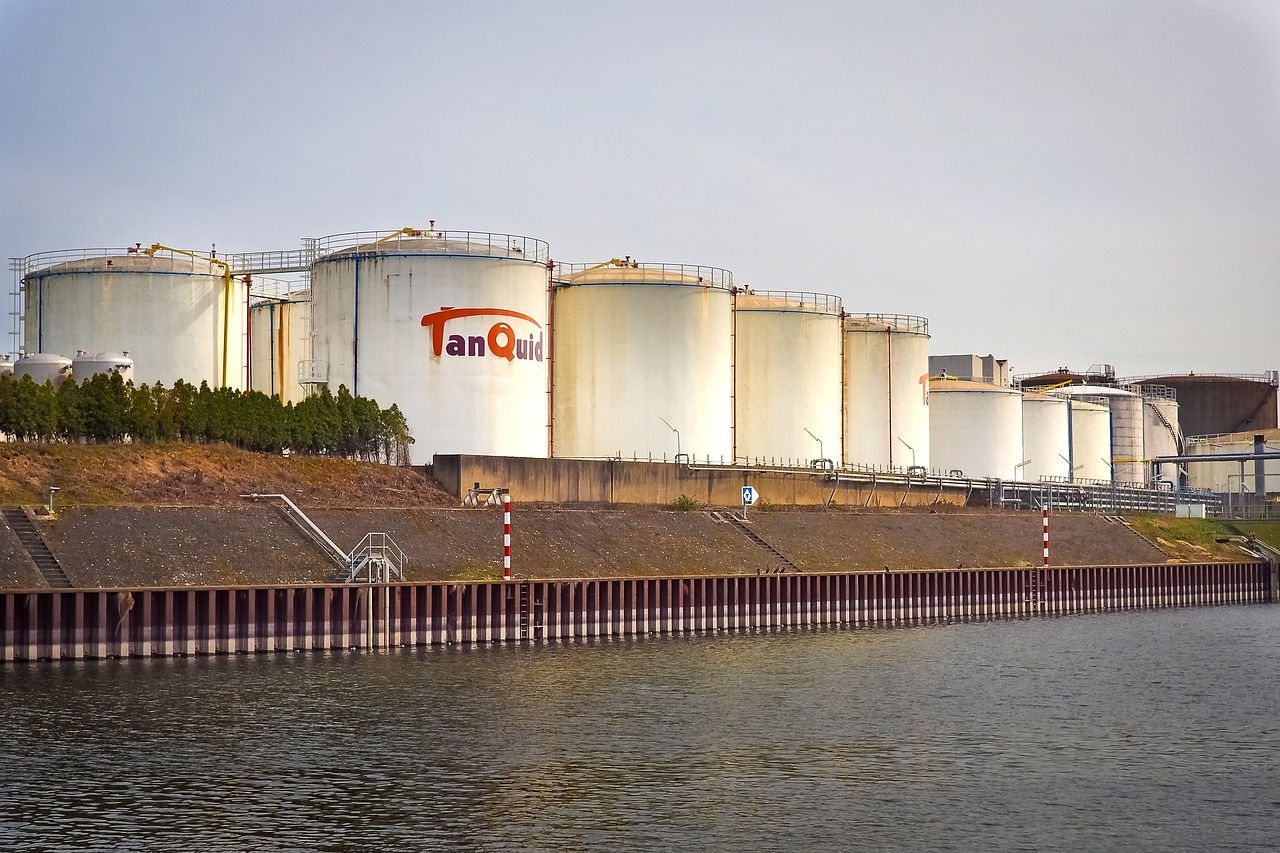
An American oligarch acquires critical energy infrastructure in Germany
A notorious donor to Donald Trump and the broader MAGA movement recently acquired a significant portion of Germany’s energy infrastructure.